In Cycladic Art What Is the Figure of a Woman Piece
The ancient Cycladic civilization flourished in the islands of the Aegean Ocean from c. 3300 to 1100 BCE.[1] Forth with the Minoan civilization and Mycenaean Greece, the Cycladic people are counted amidst the iii major Aegean cultures. Cycladic art therefore comprises ane of the 3 principal branches of Aegean fine art.
The best known type of artwork that has survived is the marble figurine, virtually unremarkably a single full-length female figure with arms folded across the front. The type is known to archaeologists as a "FAF" for "folded-arm effigy(ine)". Autonomously from a sharply-defined nose, the faces are a smooth blank, although there is evidence on some that they were originally painted. Considerable numbers of these are known, although unfortunately most were removed illicitly from their unrecorded archaeological context, which seems commonly to exist a burial.
Neolithic art [edit]
Almost all information known regarding Neolithic art of the Cyclades comes from the excavation site of Saliagos off Antiparos. Pottery of this flow is similar to that of Crete and the Greek mainland. Sinclair Hood writes: "A distinctive shape is a bowl on a high foot comparable with a type which occurs in the mainland Late Neolithic."[2]
Cycladic sculptures [edit]
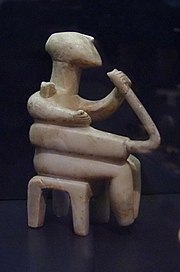
Marble harp Player (EC 2; Badisches Landesmuseum, Karlsruhe)
The best-known fine art of this catamenia are the marble figures usually called "idols" or "figurines", though neither name is exactly accurate: the former term suggests a religious part which is by no means agreed on by experts, and the latter does not properly use to the largest figures, which are most life size. These marble figures are seen scattered effectually the Aegean, suggesting that these figures were popular amongst the people of Crete and mainland Greece.[3] Peradventure the about famous of these figures are musicians: one a harp-role player the other a pipe-player.[iv] Dating to approximately 2500 BCE, these musicians are sometimes considered "the earliest extant musicians from the Aegean."[v]
The majority of these figures, still, are highly stylized representations of the female human form, typically having a flat, geometric quality which gives them a striking resemblance to today'due south modern fine art. However, this may exist a modern misconception as at that place is show that the sculptures were originally brightly painted.[6] A majority of the figurines are female, depicted nude, and with arms folded across the stomach, typically with the right arm held below the left. Near writers who have considered these artifacts from an anthropological or psychological viewpoint have assumed that they are representative of a Great Goddess of nature, in a tradition continuous with that of Neolithic female person figures such as the Venus of Willendorf.[7] Although some archeologists would concord,[8] this interpretation is not generally agreed on by archeologists, among whom at that place is no consensus on their significance. They have been variously interpreted as idols of the gods, images of death, children'southward dolls, and other things. Ane authority feels they were "more than dolls and probably less than sacrosanct idols."[9]
Suggestions that these images were idols in the strict sense—cult objects which were the focus of ritual worship—are unsupported past whatsoever archeological evidence.[ten] What the archeological prove does suggest is that these images were regularly used in funerary practise: they have all been institute in graves. Yet at least some of them show articulate signs of having been repaired, implying that they were objects valued by the deceased during life and were not made specifically for burial. Larger figures were also sometimes cleaved upward so that only function of them was buried, a miracle for which there is no explanation. These figures apparently were buried equally with both men and women.[11] Such figures were non found in every grave.[9] While the sculptures are virtually frequently plant laid on their backs in graves, larger examples may have been ready upward in shrines or dwelling places.[12]
Early Cycladic art [edit]
Early Cycladic art is divided into three periods: EC I (2800–2500 BCE), EC II (2500–2200 BCE), and EC Three (2200–2000 BCE). The fine art is past no means strictly confined to 1 of these periods, and in some cases, even representative of more than one of the Cycladic islands. The art of EC I is best represented on the islands of Paros, Antiparos, and Amorgos, while EC 2 is primarily seen on Syros, and EC 3 on Melos.[thirteen]
Early Cycladic I (Grotta-Pelos Civilisation, 3300–2700 BCE) [edit]

The most of import earliest groups of the Grotta–Pelos culture are Pelos, Plastiras and Louros. Pelos figurines are of schematic type. Both males and females, in continuing position with a head and face up, compose the Plastiras type; the rendering is naturalistic but likewise strangely stylized. The Louros blazon is seen every bit transitional, combining both schematic and naturalistic elements.[14] [15] Schematic figures are more usually plant and are very apartment in profile, having simple forms and lack a clearly defined head. Naturalistic figures are small and tend to accept foreign or exaggerated proportions, with long necks, athwart upper bodies, and muscular legs.[16]
Pelos blazon (schematic) [edit]
The Pelos blazon figurines are different from many other Cycladic figurines every bit for most the gender is undetermined. The most famous of the Pelos type figurines are the "violin"-shaped figurines. On these figurines in that location is an implied elongated head, no legs and a violin-shaped body. One detail "violin" figurine, has breasts, arms under the breasts, and a pubic triangle, peradventure representing a fertility goddess. However, since not all the figurines share these characteristics, no accurate determination can be fabricated at this time.

Cycladic marble figurine, Plastiras type
Plastiras type (naturalistic) [edit]
The Plastiras type is an early example of Cycladic figurines, named after the cemetery on Paros where they were found.[17] The figures retain the violin-like shape, opinion, and folded arm organisation of their predecessors merely differ in notable ways. The Plastiras blazon is the almost naturalistic blazon of Cycladic figurine, marked past exaggerated proportions. An ovoid head with carved facial features, including ears, sits atop an elongated neck that typically takes up a full 3rd of the effigy's total height.[eighteen] The legs were carved separately for their unabridged length, often resulting in breakages. On female figures the pubic expanse is demarcated by an incision and the breasts are modeled. Representations of males differ in construction, but not remarkably, possessing narrower hips and carved representations of the male sexual organs. The figures are typically pocket-sized in size, usually no larger than xxx centimeters, and are not able to stand on their own, as the feet are pointed. Surviving figurines have been carved from marble, just information technology is suggested past some that they may as well have been carved from woods.

Female person marble figurine from Naxos, Louros type (EC I–II, 2800–2700 BCE; Ashmolean Museum, Oxford)

Female marble figurine, Kapsala blazon (EC 2, 2700–2600 BCE; British Museum)
Louros type (schematic and naturalistic) [edit]
The Louros type is a category of Cycladic figurines from the Early Cycladic I phase of the Bronze Age. Combining the naturalistic and schematic approaches of earlier effigy styles, the Louros type have characterless faces, a long neck, and a simple body with attenuated shoulders that tend to extend past the hips in width. The legs are shaped carefully but are carved to separation no farther than the knees or mid-calves.[18] Though breasts are not indicated, figures of this type are withal suggestive of the female form and tend to bear evidence of a carved pubic triangle.
Early Cycladic II (Keros-Syros culture, 2800–2300 BCE) [edit]
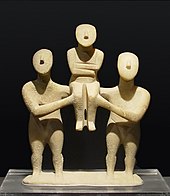
Kapsala variety [edit]
The Kapsala variety is a type of Cycladic figure of the Early on Cycladic 2 period. This variety is often idea to precede or overlap in menses with that of the canonical Spedos variety of figures. Kapsala figures differ from the approved blazon in that the artillery are held much lower in the right-beneath-left folded configuration and the faces lack sculpted features other than the nose and occasionally ears.[18] Kapsala figures show a trend of slenderness, specially in the legs, which are much longer and lack the powerful musculature suggested in earlier forms of the sculptures. The shoulders and hips are much narrower every bit well, and the figures themselves are very small in size, rarely larger than 30 cm in length. Evidence suggests that pigment is now regularly used to demarcate features such equally the optics and pubic triangle, rather than carving them straight. One feature of notation of the Kapsala variety is that some figures seem to suggest pregnancy, featuring jutting stomachs with lines drawn across the abdomen. Like other figures of the Early on Cycladic 2 menstruation, the virtually defining feature of the Kapsala diverseness is their folded-arm position.
Spedos variety [edit]

Female marble figurine, probably from Amorgos, Dokathismata variety (EC II, 2800–2300 BCE; Ashmolean Museum)
The Spedos type, named after an Early Cycladic cemetery on Naxos, is the most common of Cycladic figurine types. Information technology has the widest distribution within the Cyclades as well as elsewhere, and the greatest longevity. The group every bit a whole includes figurines ranging in height from miniature examples of eight cm to monumental sculptures of 1.v 1000. With the exception of a statue of a male person figure, now in the Museum of Cycladic Art Collection, all known works of the Spedos variety are female figures.[19] Spedos figurines are typically slender elongated female forms with folded arms. They are characterized by U-shaped heads and a deeply incised crevice between the legs.
Dokathismata variety [edit]
The Dokathismata type is a Cycladic effigy from the cease of the Early Cycladic II period of the Statuary Age. With characteristics that are developed from the before Spedos diverseness, the Dokathismata figures feature broad, angular shoulders and a straight profile. Dokathismata figures are considered the virtually stylized of the folded-arm figures, with a long, elegant shape that displays a strong sense of geometry that is especially axiomatic in the head, which features an almost triangular shape. These figures were somewhat conservatively built compared to before varieties, with a shallow leg crevice and continued feet.[eighteen] Despite this, the figures were actually quite fragile and prone to breakage. The return of an incised pubic triangle is also noted in the Dokathismata variety of figures.

Female marble figurine, Chalandriani type (EC 2, 2400–2200 BCE; British Museum)
Chalandriani variety [edit]

The Chalandriani variety is a type of Cycladic figure from the finish of the Early Cycladic Two period of the Bronze Age. Named for the cemetery on the island of Syros on which they were found, these figures are somewhat similar in style and mannerism to the Dokathismata variety that preceded them. Chalandriani figures, however, feature a more truncated shape in which the arms are very close to the pubic triangle and the leg crevice is only indicated by a shallow groove.[eighteen]
Ane feature of note with the Chalandriani variety is that the strict right-below-left configuration found in previous figures seemed to have relaxed, equally some sculptures have reversed arms or fifty-fifty abandonment of the folded position for i or both arms. The reclining position of previous figures is as well challenged, as the feet are not always inclined and the legs are somewhat rigid. The shoulders were expanded even further from the Dokathismata diversity and were quite susceptible to damage as the upper arms and shoulders are also the thinnest point of the sculpture. The head is triangular or shield-shaped with few facial features other than a prominent olfactory organ, continued to the body by a pyramidal-shaped neck. Like figures of the Dokathismata variety, some Chalandriani figures appear to exist presented every bit pregnant. The defining characteristic of these figures is their bold and exaggerated indication of the shoulders and upper arms.
Early Minoan examples [edit]
Koumasa variety [edit]
Koumasa figurines, from the Early Minoan II cemetery at Koumasa on Crete, are very small and apartment. The folded-arm figures typically accept brusque legs and broad shoulders,[20] and were prone to breakage given their delicate build.[21]

Cycladic "frying pan", terra cotta with stamped and cut spirals decoration (EC I–II, c. 2700 BCE, Kampos phase)
Pottery [edit]
The local clay proved difficult for artists to work with, and the pottery, plates, and vases of this menses are seldom higher up mediocre.[xiii] Of some importance are the and then-chosen 'frying pans', which emerged on the island of Syros during the EC Two phase. These are circular decorated disks, which were not used for cooking, but perhaps as fertility charms or mirrors.[22] Some zoological figurines and pieces depicting ships have too been plant.
Also these, other forms of functional pottery have been found. All pottery of early Cycladic civilization was made by hand, and typically was a black or cerise color, though pottery of a stake buff has also been found. The near mutual shapes are cylindrical boxes, known as pyxides, and collared jars.[sixteen] They are rough in construction, with thick walls and crumbling imperfections, but sometimes feature naturalistic designs reminiscent of the sea-based culture of the Aegean islands. There are also figurines of animals.
Gallery [edit]
-

Female torso in darker rock with a pigsty in the pharynx and dírkama thighs, Plastiras type (EC I, 2800–2700 BCE; Museum of Prehistoric Thera) -

Early terracotta figurines from Santorini (c. 2100 BCE; Museum of Cycladic Culture)
-

Gold figure of an ibex from Santorini, tardily Cycladic (17th century BCE)
See also [edit]
| External video | |
|---|---|
 | |
 Male harp thespian from Keros (EC 2, c. 2600–2300 BC; National Archaeological Museum, Athens), Smarthistory[23] Male harp thespian from Keros (EC 2, c. 2600–2300 BC; National Archaeological Museum, Athens), Smarthistory[23] |
- Akrotiri (prehistoric urban center) for additional creative, decorative, and functional items excavated from an aboriginal Cycladic site.
- Keros-Syros civilisation
- Grotta–Pelos culture
Notes [edit]
- ^ Adams, Laurie (1999). Art Beyond Time (4th ed.). Mc-Graw Hill. p. 112.
- ^ Hood 28
- ^ Doumas, p. 81
- ^ Higgins, p. 61
- ^ Higgins, p. sixty
- ^ Getty Museum, past exhibition "Prehistoric Arts of the Eastern Mediterranean"
- ^ Marija Gimbutas, The Linguistic communication of the Goddess, HarperCollins 1991 p. 203; Erich Neumann, The Great Mother: An Assay of the Classic tr. Ralph Manheim, Princeton University Printing, 2nd ed. 1963, p. 113.)
- ^ J. Thimme, Die Religioese Bedeutung der Kykladenidole, Antike Kunst 8 (9165), pp. 72–86
- ^ a b Emily Vermeule, Greece in the Bronze Age, Academy of Chicago Press 1974, p. 52.
- ^ L. Marangou, Cycladic Civilisation: Naxos in the 3rd Millennium BC Athens 1990 pp. 101, 141 [sic]
- ^ Marangou p. 101
- ^ Bothmer, Bernard (1974). Cursory Guide to the Department of Egyptian and Classical Art. Brooklyn, NY: The Brooklyn Museum. p. 20.
- ^ a b Higgins 53
- ^ "Cycladic Culture". Lake Woods College. Retrieved 11 November 2014.
- ^ Vianello, Andrea. "Cycladic figurines in funerary rituals". BrozeAge.org. Archived from the original on 21 April 2018. Retrieved 11 November 2014.
- ^ a b Fitton, J. Lesley (1989). Cycladic Art. London: British Museum Press. p. 22. ISBN978-0714112930.
- ^ Getz-Preziosi, Pat (1987). Early Cycladic Art in North American Collections. Seattle and London: University of Washington Press. p. 52.
- ^ a b c d e Getz-Gentle, Pat (2001). Personal Styles in Early on Cycladic Sculpture . Seattle and London: University of Washington Press.
- ^ Spedos variety figurine Archived 2014-08-19 at the Wayback Motorcar The Museum of Cycladic Art
- ^ "Cycladic art: figure in the Koumasa diverseness". Bradshaw Foundation.
- ^ Getz-Preziosi, Pat (1982). "Risk and Repair in Early Cycladic Sculpture" (PDF). Metropolitan Museum Journal. 18: 24.
- ^ Higgins 54
- ^ "Harp Player, Early Cycladic period (Bronze historic period)". Smarthistory at Khan Academy. Retrieved September 8, 2014.
References [edit]
- Doumas, Christos (1969). Early Cycladic Art. Frederick A. Praeger, Inc.
- Higgins, Reynold (1967). Minoan and Mycenaean Art. Thames and Hudson.
- Hood, Sinclair (1978). The Arts in Prehistoric Greece. Penguin Books.
External links [edit]
- The Cycladic Sculptures
- Greek art of the Aegean Islands, Issued in connection with an exhibition held November 1, 1979 – February ten, 1980, Metropolitan Museum of Art, New York, sponsored by the Authorities of the Republic of Greece, complemented by a loan from the Musée du Louvre
Source: https://en.wikipedia.org/wiki/Cycladic_art#:~:text=With%20the%20exception%20of%20a,incised%20cleft%20between%20the%20legs.
0 Response to "In Cycladic Art What Is the Figure of a Woman Piece"
Enregistrer un commentaire